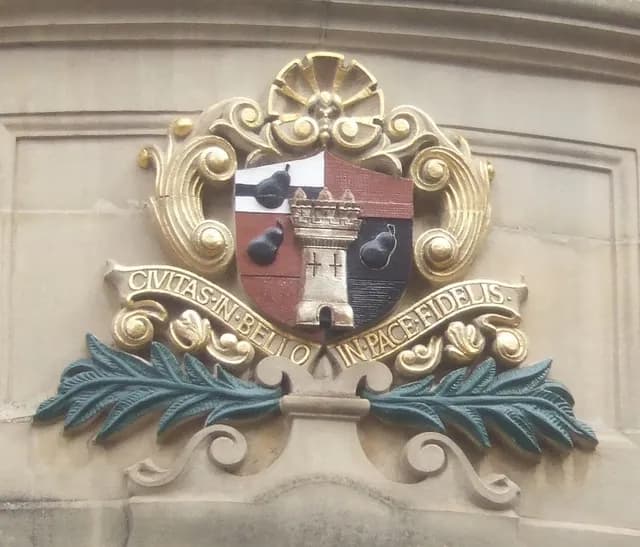
Walk through Worcester today and you will see the Latin words everywhere: Floreat semper fidelis civitas on the Guildhall, Civitas in bello et pace fidelis on the railway bridge at Foregate Street. The city has worn its nickname "The Faithful City" for centuries. Yet the uncomfortable truth is that this reputation was not earned on the battlefield in 1651; it was invented nearly a decade later, in a failed attempt to extract money from the newly restored King Charles II.
A Decisive Defeat
The Battle of Worcester, fought on 3 September 1651, was the final engagement of the English Civil Wars. Oliver Cromwell commanded a Parliamentarian force of approximately 28,000 men against a Royalist army of 16,000, mostly Scottish troops, led by the young Charles II. The result was never in serious doubt. Cromwell's forces inflicted around 3,000 Royalist casualties and captured some 10,000 prisoners, at a cost of roughly 700 Parliamentarian lives. The Royalist cause in England was finished. Cromwell, in his despatch of 4 September, called the victory a "crowning mercy."
What happened next to Worcester itself is less celebrated in civic memory. Parliamentary troops looted the city, causing an estimated £80,000 worth of damage. The cathedral, which had been used to store Royalist arms, suffered damage during the conflict. For the ordinary citizens of Worcester, the battle brought destruction, not glory.
An Equivocal Record
Worcester's actual conduct during the Civil Wars does not support the myth of unwavering Royalist loyalty. At the outbreak of hostilities in 1642, the city initially declared for Parliament. Only later did Royalist forces occupy it. In 1646, Worcester surrendered to Parliamentary troops. When Charles II's Scottish army approached in 1651, the city council voted to surrender rather than risk further destruction. Throughout the First Civil War, Worcester had taken what historians describe as a "pragmatic position," declaring loyalty to whichever side happened to be in occupation at the time.
This was sensible behaviour for a trading city concerned with self-preservation. It was not, however, the stuff of which legends of steadfast Royalist devotion are made.
The Invention of Tradition
The phrase Fidelis Civitas (The Faithful City) appears nowhere in contemporary records of the battle. It emerged only after the Restoration of the monarchy in 1660, when Worcester's civic leaders sought to exploit their city's status as the site of the final battles of both the First Civil War (1646) and the Third Civil War (1651) to mount a compensation claim against Charles II. The claim was cynical, unsuccessful, and entirely without historical foundation. Worcester had "no particular claim to being loyal to the King," as modern historians have noted.
Despite the failure of the financial appeal, the motto stuck. It was incorporated into the city's coat of arms, alongside the three black pears that had been granted in 1634. The civic architecture of the eighteenth and nineteenth centuries gave the myth physical permanence. The Guildhall, built in 1721, carries the motto prominently. The Foregate Street railway bridge and the gates of Cripplegate Park both proclaim Worcester's supposed faithfulness. By the Victorian era, the invented tradition had become established fact in the minds of most citizens.
Sites of Memory
Several locations around Worcester preserve this complicated history. The Commandery, on Sidbury, served as Royalist headquarters during the 1651 battle and is now a museum. Fort Royal Hill, a redoubt built by the Royalists and later captured by Parliamentarians, is now a public park; a plaque there commemorates the visit of John Adams and Thomas Jefferson in April 1786. Adams, later the second President of the United States, was struck by how little locals knew of the battle and delivered an impromptu lecture, reportedly telling his audience: "Tell your neighbours and your children that this is holy ground."
Sidbury Gate bears a plaque quoting Cromwell's "crowning mercy" despatch. King Charles House on Cornmarket marks where Charles II had his headquarters during the battle. These sites testify to the battle's significance; they do not, however, prove that Worcester itself was particularly faithful to the Royalist cause.
Modern Reckoning
Contemporary historians, including Malcolm Atkin in his 2004 work, have examined primary sources to dismantle the "Faithful City" narrative. The evidence shows a city that adapted to changing military realities, not one that stood firm for king and crown. The myth persists because it serves civic pride, not because it reflects historical reality.
Worcester's experience is not unique. Many English towns constructed flattering historical narratives in the centuries after the Civil Wars. What distinguishes Worcester is how thoroughly the myth was embedded in civic identity, through architecture, official seals, and repeated assertion. The Faithful City was, in the end, faithful not to the Royalist cause, but to itself.