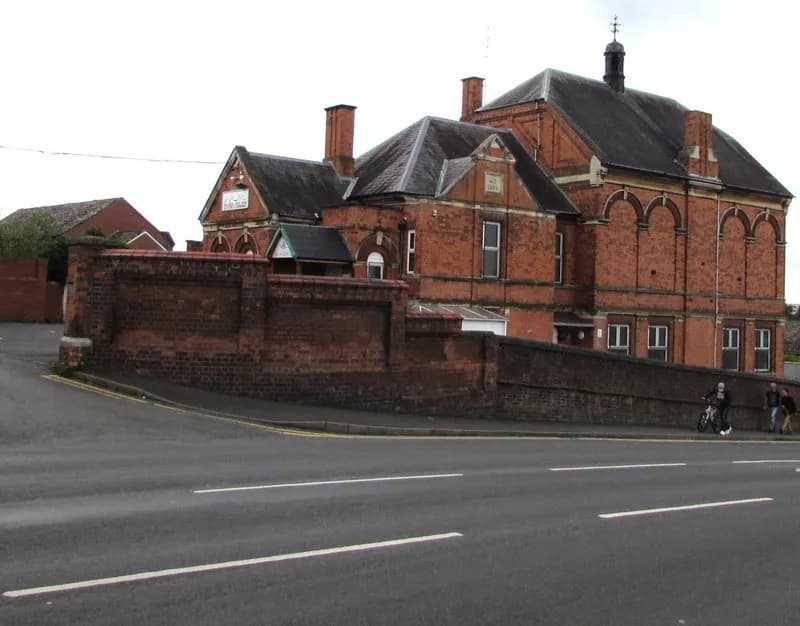
In a basement beneath 63 Broad Street nearly two centuries ago, a barrel of rejected sauce sat forgotten for eighteen months. When two Worcester chemists finally opened it, they discovered something extraordinary; a sharp, pungent liquid had mellowed into the complex, savoury condiment now recognised worldwide as Lea and Perrins Worcestershire Sauce.
The Chemists of Broad Street
John Wheeley Lea and William Henry Perrins were Worcestershire men through and through. Lea was born in Feckenham in 1792, whilst Perrins came from Chaddesley Corbett in 1793. The pair formed their partnership in 1823 and established their chemist and druggist business at 63 Broad Street in 1837, with a stationer's shop occupying number 61 next door.
The two men were more than mere shopkeepers. Lea served as Mayor of Worcester twice, in 1835 and again in 1849 to 1850, and became an alderman in 1864. He died in March 1874 at Stanfield House in Upper Wick and lies buried at St Peter's Church in Powick. Perrins, who resided at Lansdowne Crescent in Claines, died in January 1867 and was interred at St John the Baptist Churchyard in Claines. Their local roots ran deep, and their civic contributions extended well beyond their famous sauce.
The Origin Story: Myth and Reality
Company lore long held that the sauce originated from a recipe brought back from India by Lord Sandys of Ombersley Court, who supposedly encountered a similar condiment whilst serving with the East India Company in the 1830s. According to this account, Lord Sandys commissioned Lea and Perrins to recreate the sauce for his own table.
Historical records, however, cast doubt upon this romantic tale. Marcus Sandys, 3rd Baron Sandys, never served as Governor of Bengal, and no evidence exists that he visited India at all. He did serve as Member of Parliament for Evesham from 1838 to 1852, and his family seat at Ombersley Court lay within the county. A memorial to him hangs on the south wall of St Andrew's Church in Ombersley. Early bottles carried the words "from the recipe of a nobleman in the county," yet the India connection appears to be later embellishment.
What is documented is the accidental nature of the sauce's creation. When first mixed, the liquid proved so strong and pungent that the chemists deemed it inedible. They abandoned the barrel in their cellar, where it sat maturing for a year and a half. Upon rediscovering and tasting it again, they found fermentation had transformed the harsh mixture into something remarkably palatable.
From Local Pharmacy to Global Export
The first commercial bottles reached the public in 1838, though some sources suggest limited sales began in 1837. Success came swiftly. By 1839, the Duncan family of New York had begun importing the sauce to the United States, marking the beginning of its international reach.
The product's popularity brought challenges. Counterfeit versions appeared almost immediately, prompting Lea and Perrins to introduce their signature label design in November 1874 to distinguish genuine sauce from "spurious imitations."
For sixty years, production remained at the Broad Street premises. On 16 October 1897, manufacturing relocated to a purpose-built factory on Midland Road, named for the railway that served it. The site featured dedicated rail sidings for receiving raw materials and dispatching finished goods. That same factory continues production today, owned by Kraft Heinz since 2005, making Worcestershire Sauce a rare example of a globally distributed product still manufactured in its city of origin.
Secrets in a Skip
The company guarded its recipe jealously. In 2009, however, an extraordinary discovery came to light when Worcester City Museums announced that former employee Brian Keogh had recovered handwritten recipes from a skip at the Midland Road site during the early 1980s. Keogh's daughter, Bonnie Clifford, worked with the museum to display his collection.
The documents revealed nineteenth-century ingredients including vinegar, molasses, sugar, salt, anchovies, tamarind extract, onions, garlic, cloves, soy, acetic acid, essence of lemons, peppers and pickles. Some components were recorded in code; one ingredient was listed simply as "bulldog." The find offered a rare glimpse into the sauce's closely guarded formulation.
What Remains
Today, the Midland Road factory produces ready-mixed bottles for the United Kingdom and Canadian markets, along with concentrate shipped abroad for local bottling. The company that began in a Broad Street pharmacy has outlasted its founders by more than 150 years, yet it never left Worcester.
For a city whose cathedral dominates the skyline and whose porcelain once graced tables across the Empire, Worcestershire Sauce represents another strand of manufacturing heritage; one that began with a forgotten barrel in a cellar and grew into a kitchen staple recognised from New York to Mumbai. The chemists of 63 Broad Street could hardly have imagined that their accidental creation would outlive them both, still flowing from the same city nearly two centuries later.