The Humble Cottage That Launched a Musical Giant
Edward William Elgar, one of Britain's most celebrated composers, entered the world in a modest setting. He was born on 2 June 1857 at The Firs, a cottage in Lower Broadheath, approximately three miles north-west of Worcester city centre. The fourth of seven children to William Henry and Ann Elgar, he lived at The Firs for just his first two years before the family moved into Worcester itself.
Today, The Firs stands as a Grade II listed building, preserved as the Elgar Birthplace Museum. The cottage and its surrounding garden, with views across the Worcestershire countryside towards the Malvern Hills, remain open to visitors. The museum displays a piano sold by Elgar's father from his Worcester music shop, a tangible connection to the family business that would shape the young Edward's musical foundations.
A Musical Household in the Heart of Worcester
The move to Worcester placed young Edward at the centre of a vibrant musical environment. His father, William Henry Elgar, had arrived in Worcester in 1841 from Dover, where he had trained as a piano tuner with a London music publisher. He established a shop selling sheet music and musical instruments, creating a hub where music was both trade and conversation.
William Elgar's influence extended beyond commerce. From 1846 until 1885, he served as organist at St George's Roman Catholic Church in Worcester. His work tuning pianos at grand houses across Worcestershire often took him into the homes of the county's established families, and he occasionally brought young Edward along, giving the boy opportunities to display his developing musical abilities before influential local figures.
The Cathedral as Classroom
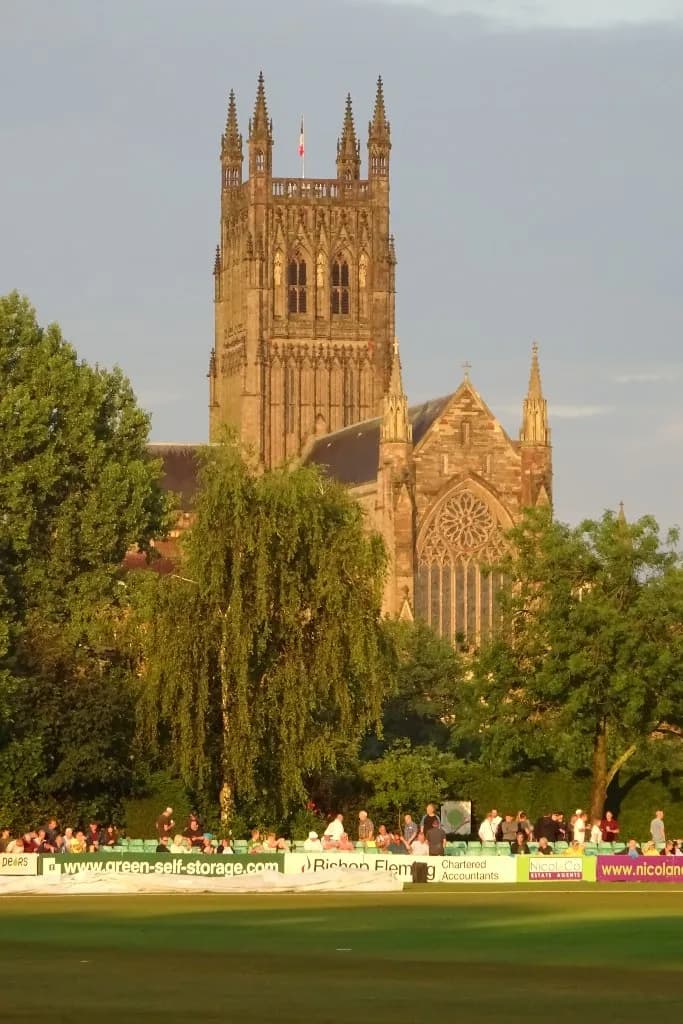
Worcester Cathedral provided Elgar with what he later described as his true musical education. He recalled: "My first music was learnt in the Cathedral … from books borrowed from the music library, when I was eight, nine or ten." The cathedral's extensive music collection, which includes works by Elgar and his predecessor Thomas Tomkins, became his classroom. He received piano and violin lessons from local teachers and studied organ playing through instruction manuals, consuming every book on music theory he could locate.
The cathedral's significance in Elgar's life was later recognised nationally; the west facade appeared on the reverse of the Series E £20 banknote issued between 1999 and 2007 to commemorate the composer. Within the cathedral library, the Worcester Antiphoner survives as the only book of its kind from the Reformation period, a reminder of the centuries of musical tradition that surrounded the young Elgar.
From Assistant to Organist at St George's
Elgar's formal connection to St George's Roman Catholic Church deepened when he became assistant organist at age 15. In 1885, at 27 years old, he succeeded his father as organist, holding the post for four years until 1889. The organ installed during his tenure was rebuilt in 1970; stops from the original instrument are marked with an "E" to indicate those Elgar himself played.
Elgar's Roman Catholic faith, inherited from his mother's conversion before his birth, set him apart in a predominantly Anglican city. This religious identity would later surface in his compositions, most notably in "The Dream of Gerontius," a work rooted in Catholic theology that some Anglican establishments initially received with caution.
The Three Choirs Festival: Worcester's Gift to a Career
The Three Choirs Festival, the oldest extant music festival in Europe, rotates annually among the cathedrals of Hereford, Gloucester, and Worcester. First held in 1715, the festival became the crucial vehicle for launching Elgar's professional reputation.
In 1890, the Worcester Festival Committee commissioned Elgar's first major work, the "Froissart" Overture. Elgar conducted the premiere in Worcester that September, marking his arrival as a composer of serious orchestral music. Nine years later, the revised version of his "Enigma Variations" — the version audiences recognise today — received its first performance at Worcester Cathedral during the 1899 Three Choirs Festival.
Throughout much of the 20th century, Elgar's works dominated the festival programme. His father's earlier role in introducing masses by Cherubini and Hummel to the festival orchestra had helped establish the family's connection to this institution decades before Edward's own contributions.
Worcester's Musical Circles
Beyond the cathedral and festival, Worcester offered Elgar numerous outlets for practical musicianship. From 1879 to 1884, he served as conductor of the attendants' band at Powick Asylum, travelling there once a week to lead rehearsals and composing or arranging music for the unusual instrumental combinations available. The experience sharpened his skills in orchestration and working with amateur musicians.
He held a teaching post as professor of the violin at Worcester College for the Blind Sons of Gentlemen and was an active member of the Worcester Glee Club, where he accompanied singers, played violin, composed and arranged works, and conducted for the first time. A family wind quintet featuring Elgar on bassoon and his brother Frank on oboe performed works by Mozart, Beethoven, and Haydn, providing further training in arranging and ensemble playing.
Return to Worcestershire
After a brief period in London between 1889 and 1891, Elgar and his wife Alice returned to Worcestershire, settling in Great Malvern. Though they later moved to Plâs Gwyn in Hereford between 1904 and 1911, Elgar maintained strong connections to his home county throughout his life.
He received his knighthood at Buckingham Palace on 5 July 1904, and later served as Peyton Professor of Music at the University of Birmingham from 1905 to 1908. When he died in 1934, he was buried alongside Alice at St Wulstan's Roman Catholic Church in Little Malvern.
A Lasting Legacy
The Elgar Birthplace Museum, established by his daughter Carice in the year of his death, has preserved The Firs and its collection for successive generations. The National Trust assumed administration in 2016, and visitor numbers have since increased from approximately 10,000 to nearly 30,000 annually. The museum holds Accredited Museum status from Arts Council England.
W. H. Reed, Elgar's friend and biographer, observed that the composer's early Worcestershire surroundings had an influence that "permeated all his work and gave to his whole life that subtle but none the less true and sturdy English quality." From the small cottage at Broadheath to the cathedral library, from his father's music shop to the Three Choirs Festival, Worcester provided the environment where a self-taught boy could develop into one of Britain's most distinctive musical voices.